Trezor shipping breach: when a leaked delivery address shows you own crypto
No wallets or recovery words were taken. But a parcel label says who you are, where you live and that you bought a crypto wallet, and Trezor itself warns about physical safety.
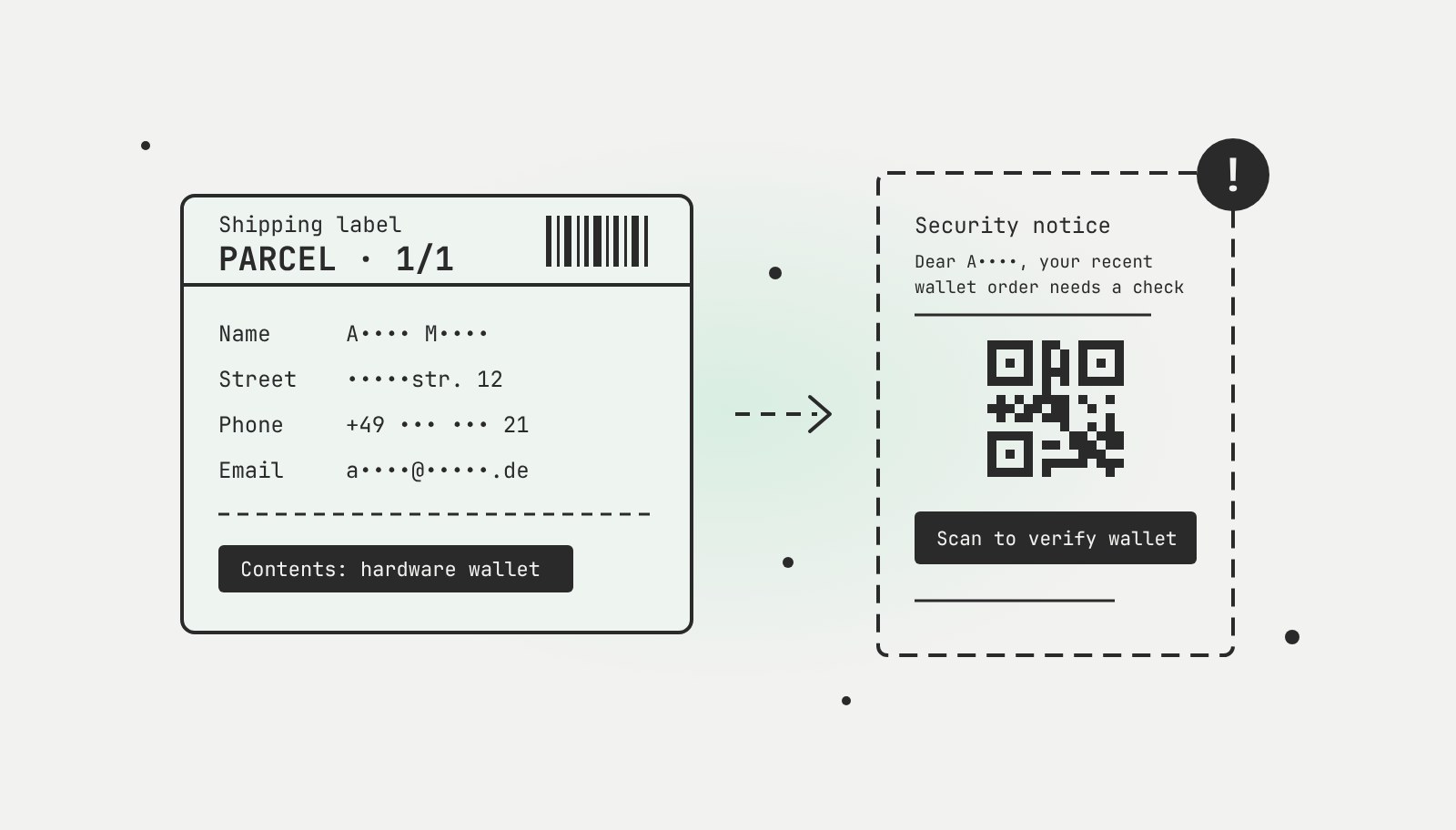
On 16 November, the hardware wallet maker Trezor told customers that Skladon, one of its shipping partners, had been breached. Skladon informed Trezor on 15 November of unauthorised access to systems holding Trezor customer shipping data, after a breach on 7 November. Trezor believes the attacker exported data for about 27,000 orders placed between 9 August and 7 November 2026. The investigation is ongoing, and Trezor says it has informed the data protection authority.
What was taken
- Full name
- Phone number
- Delivery address
- Email address
- Order date and details: the product bought and its price
Trezor says its own systems were not compromised and that no wallet backups, PINs or passphrases were involved, because neither Trezor nor Skladon ever holds them. Skladon delivers to many countries, so the leak isn't limited to one region. Affected customers were emailed. A small number who ordered between 9 and 14 August may also be affected but can't be emailed, because their details had already been anonymised under Trezor's 90-day retention policy.
How scammers use order data
Trezor says some customers have already reported scam calls, and The Block reports callers posing as Trezor support. Expect calls, texts, emails and even letters that quote what you bought and what you paid, because that detail makes a message feel genuine. The goal is almost always the same: get you to type your wallet backup (the recovery words) into a website, read it out, or install fake software. We've seen the same pattern with fake letters after the Maileva breach.
Then there's what's already public. If your address, employer or relatives are listed on people-search sites and directories, a criminal can join that to the order data: a fake caller who knows your street and your neighbours' names sounds very convincing.
It's not the first time
In August, another Trezor shipping provider, ShipMonk, was breached. After an update in September, the total reached 80,689 customers. That breach also included order data from 2019 to 2021, which Trezor says ShipMonk had confirmed in writing it had deleted. It hadn't. The lesson goes beyond Trezor: every company that packs, ships or emails for a shop holds a copy of your details, and you rarely know who they are.
What to do now
Treat any unexpected call, message or letter about your order as suspicious. Contact Trezor only through trezor.io/support, never through a link, QR code or phone number in a message. Trezor says it will never cold-call you.
Never share your wallet backup with anyone, and never enter it anywhere except on your Trezor device. No real support agent will ask for it. Here's how fake support calls work.
Be careful about who knows you own crypto, online and offline. If anything you receive feels threatening, go to the police first.
For future orders, use a parcel locker or pickup point. Trezor now offers Anonymous Pickup in 18 European countries, so your home address never reaches it.
Use your GDPR rights
Under Art. 15 GDPR, you can ask Trezor for a copy of your data, including the recipients it was shared with and how long it will be stored. That tells you which shipping and service partners hold your address. Once your order has arrived, you can ask for erasure under Art. 17. A shop may keep some records where the law requires it, such as invoices for tax purposes. If you get no proper answer, complain to your data protection authority.
You can't take back a leaked parcel label, but you can make your address harder to find. Our data broker opt-out guide explains how. BetterPrivacy searches people-search sites, data brokers, directories, forums and news archives for your details, helps you send GDPR or CCPA removal requests and tracks each takedown. A free scan shows your top 3 results in full.
Sources
- Data breach at Trezor shipping partner, Skladon (16 November 2026) — Trezor
- Recent customer data exposed in shipping provider incident (updated 4 September 2026) — Trezor
- Trezor hit by another shipping partner data leak, affecting 27,000 Skladon orders (16 November 2026) — The Block
- Art. 15 GDPR – Right of access by the data subject — gdpr-info.eu (text of Regulation (EU) 2016/679)
- Art. 17 GDPR – Right to erasure ('right to be forgotten') — gdpr-info.eu (text of Regulation (EU) 2016/679)